

Sodom & Gomorrah: Example of Judgment


Photo Gallery
Places of Interest
Sodom & Gomorrah
Example of Judgment to Come
Introduction
1. Because the Dead Sea basin used to be like the Garden of Eden, it was an extremely desirable climate that was great for agriculture and life in general. It was, therefore, a very populated area. The Bible seems to indicate that the whole lower Jordan Valley and the Dead Sea basin area toward the area of Egypt was like the Garden of Eden. Genesis 13:10: Lot lifted up his eyes and saw all the valley of the Jordan, that it was well watered everywhere—this was before the Lord destroyed Sodom and Gomorrah—like the garden of the Lord, like the land of Egypt as you go to Zoar.
2. The thought of God raining down fire and brimstone upon the cities and people in this area is staggering and can give us chills up and down our spines when we really contemplate what happened here. This fire and brimstone were so hot and intense that they destroyed everything in their path.
3. God also used Sodom and Gomorrah to refer to all of the cities of the Dead Sea basin.
4. There was a total of five large cities, in this basin. Sodom, Gomorrah, Admah, Zeboim, and Zoar. It appears Zoar was the only city spared. However, the Bible indicates it may have been destroyed as well. These cities were reduced to ashes with nothing left after their destruction.
5. Where were these cities located? There has been much debate on this issue. We'll provide some helpful orientation to what the evidence supports.
6. There are five areas around the Dead Sea where sulfur balls can mainly be found. In our tour trips to Israel, we focus on these cities using the site right below Masada. The sulfur balls here are 90-95% pure, unlike other sulfur found in the world which is around 40% pure. They can be lit on fire and burn right before your very eyes.
7. On our tours, we allow people time to search for some sulfur balls in the area below Masada that many believe to be ancient Gomorrah.
Location of Sodom, Gomorrah, and the Other Cities
1. Not everyone agrees on the locations of Sodom, Gomorrah, and the other cities.
2. Some believe the cities are located on the northeastern side of the Dead Sea. Others think they are on the southeastern side of the Dead Sea, and still others believe they are on the western side of the Dead Sea.
3. God says that He reduced the cities to ashes, so according to the Bible, we shouldn't expect to find much archaeological evidence.
4. In total, God destroyed at least four of the five large cities around the Dead Sea.
5. Josephus, a historian and writer during the time of Christ, said the ruins could still be seen in his day.
6. We'll look at each of these location theories and provide evidence to see which of them best fits the Bible, archaeology, and history.
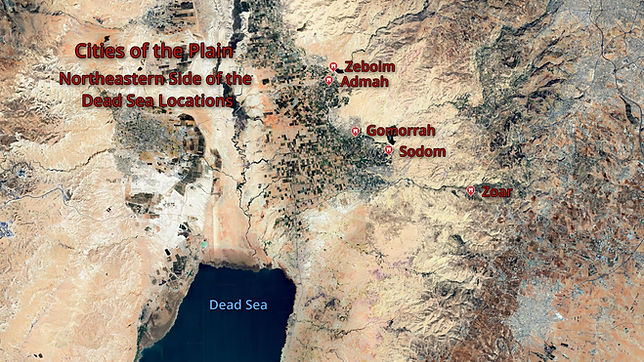
Northeastern Side of the Dead Sea Location

Evidence supporting the five cities on the northeastern side of the Dead Sea. This theory believes the following sites today are the five cities of the plain:
-
Tall el-Hammam (Sodom)
-
Tall Kefrein (Gomorrah)
-
Tall Nimrin (Admah)
-
Tall Bleibel and Tall Mustah together (Zeboim)
-
Serabit el-Mushaggar (Zoar)
1. The northeastern theory depends heavily on Genesis 13. In that story, Abraham and Lot separate. Lot looks east from the area of Bethel and Ai and sees the “plain of the Jordan,” which was well watered. He chooses that area and later moves his tents toward Sodom.
2. The Hebrew word for “plain” is kikkar, which can mean a round, flat area, like a circle or disk. Supporters of the northeastern theory say this perfectly matches the broad plain just northeast of the Dead Sea, where the Jordan River flows and enters the Dead Sea. From Bethel, that northern plain would have been visible, while the southern basin would not.
3. Tall el-Hammam was a very large, important Bronze Age city in the lower Jordan Valley northeast of the Dead Sea.
4. It is described as the largest continuously occupied Bronze Age city in the southern Levant, with a massive upper city, lower city, strong walls, and a major gate. That makes it look like a good candidate for a leading city such as Sodom.
5. The theory also gained attention because of the proposed airburst destruction. A cosmic airburst event occurs when a comet or asteroid explodes in the Earth's atmosphere, releasing immense energy and causing widespread destruction without leaving a traditional impact crater.
Researchers claimed Tall el-Hammam showed a dramatic destruction layer, intense heat, melted materials, and violent trauma, which they argued matched the Bible’s picture of fire from heaven.
Evidence against the cities on the northeastern side of the Dead Sea.
1. The famous airburst study is a question of debate. Some articles support it while others do not. One article says critics found major problems in the methods and interpretation, and the journal formally withdrew the paper.
2. A second major problem is chronology. The destruction of Tall el-Hammam is dated to about 1650 BC. However, traditional biblical chronology places Abraham and the destruction of Sodom much earlier, around 2067 BC. That leaves a gap of more than 400 years.
3. A third weakness is biblical geography. Genesis 10:19 and Ezekiel 16:46 point more naturally to a southern location. Ezekiel says Sodom was south of Jerusalem, but Tall el-Hammam is northeast of Jerusalem. Ezekiel 16:46: And your elder sister is Samaria, who lived with her daughters to the north of you; and your younger sister, who lived to the south of you, is Sodom with her daughters. The context of this verse is spoken from Jerusalem.
4. As mentioned above, the Hebrew word for “plain” is kikkar, which can mean a round, flat area, like a circle or disk. However, there is another way to read the passage. The word kikkar may not refer only to that one northern area. In the Bible, it can be used more broadly for parts of the Jordan Rift Valley. Also, Genesis says Lot first traveled east into the plain but later moved his tents “as far as Sodom.” That suggests movement over time. So, Lot may first have entered the northern plain and later moved farther south.
5. Another problem is the location of Zoar. Tel es-Safi, at the southeastern end of the Dead Sea, shows long occupation across many periods and fits the biblical idea that Zoar survived when the other cities were destroyed. That makes it one of the strongest archaeological anchors for the southern theory. If Zoar was really at this location, then Sodom and Gomorrah were likely nearby in the south, not up north at Tall el-Hammam. Lot could not likely have fled from Tall el-Hammam to es-Safi (a distance of 60 miles or 90 km) in the short time described in Genesis 19.
6. The Bible seems to indicate that the whole lower Jordan Valley and the Dead Sea basin area toward the area of Egypt was like the Garden of Eden. Genesis 13:10: Lot lifted up his eyes and saw all the valley of the Jordan, that it was well watered everywhere—this was before the Lord destroyed Sodom and Gomorrah—like the garden of the Lord, like the land of Egypt as you go to Zoar. It seems that the five cities of the plain were spread out over this whole area. The northeastern location theory has the five cities very close together.
7. The Bible says the cities that were destroyed were reduced to ashes. Therefore, we shouldn't expect to find ruins there. The cities proposed in this view as being destroyed, have ruins there.
Summary
The Tall el-Hammam view is supported mainly by the site’s great size, importance, and possible fit with the Jordan plain in Genesis 13. But it is weakened by the retraction of the airburst study, the dating problem, the biblical geography problem, and the stronger southern case for Zoar. The overall conclusion is that Tall el-Hammam is impressive, but it has some strong evidence against it.
Southeastern Side of the Dead Sea Location
Evidence supporting the five cities on the southeastern side of the Dead Sea. This theory believes the following sites today are the five cities of the plain:
-
Bab edh-Dhra (Sodom)
-
Numeira (Gomorrah)
-
Es-Safi (Zoar)
-
Feifa (Admah)
-
Khanazir (Zeboim)
1. The theory has strong support from Bible geography, geology, and historical memory.
2. In Genesis 10:19, the border of Canaan is described in a way that seems to move south toward Gerar and Gaza and then east toward Sodom, Gomorrah, Admah, and Zeboiim. This fits naturally with a southern location.
3. Another important clue comes from Ezekiel 16:46, where in the context of the verse, Samaria is to the north and Sodom is to the south of Jerusalem. Ezekiel 16:46: And your elder sister is Samaria, who lived with her daughters to the north of you; and your younger sister, who lived to the south of you, is Sodom with her daughters. The context of this verse is spoken from Jerusalem. Since Samaria really is north of Jerusalem, the mention of Sodom to the south seems to support a southern Dead Sea setting as well.
4. The Bible’s references in Genesis 10, Genesis 14, Ezekiel 16, and Genesis 19 fit the southeastern Dead Sea fairly well, especially the ideas of the Valley of Siddim, bitumen pits, and Zoar nearby.
5. Ancient writers like Josephus and Eusebius, along with the Madaba Map, also place Zoar and the Sodom tradition in the south. The site of es-Safi is especially important because it likely preserves ancient Zoar and shows long-term occupation.
6. Archaeologically, Bab edh-Dhra (Sodom) and Numeira (Gomorrah) support the southeastern location theory because they were real towns, had evidence of destruction by fire, and sat in a fertile area that matches the Bible’s picture of a well-watered plain.
7. Es-Safi (Zoar) is especially important. It shows long occupation across many periods and fits the biblical idea that Zoar survived when the other cities were destroyed. Deuteronomy 34:3, and Isaiah 15:5, seem to indicate Zoar's existence long after the other cities were destroyed. That makes it one of the strongest archaeological anchors for the southeastern theory.
8. There have been found some sulfur balls around the four cities that were destroyed. This matches the biblical narrative.
9. There has been found an ash layer in all the cities except Zoar.
Evidence against the five cities on the southeastern side of the Dead Sea.
1. Feifa (Admah) and Khanazir (Zeboim) seem to have been cemeteries, not cities.
2. According to some research, Bab edh-Dhra (Sodom) and Numeira (Gomorrah) were likely destroyed about 250 years apart, not in one single event.
3. The Bible presents Sodom and Gomorrah as destroyed together in one event. But, according to some research, Bab edh-Dhra (Sodom) was destroyed around 2350 BC, while Numeira (Gomorrah) was destroyed around 2600 BC, about 250 years earlier. If those dates are correct, the two sites do not fit the biblical picture of simultaneous destruction. It also reveals that they were destroyed between 300-600 years before the time of Abraham.
4. The claim that the Ebla tablets mentioned the five cities is no longer accepted. The Ebla tablets are a collection of approximately 1,800 complete clay tablets and 4,700 fragments discovered in the palace archives of the ancient city of Ebla, Syria, during excavations in 1974–75.
5. The Bible says the cities that were destroyed were reduced to ashes. Therefore, we shouldn't expect to find ruins there. The four cities that are proposed in this view as being destroyed, have ruins there.
6. The Bible seems to indicate that the whole lower Jordan Valley and the Dead Sea basin area toward the area of Egypt was like the Garden of Eden. Genesis 13:10: Lot lifted up his eyes and saw all the valley of the Jordan, that it was well watered everywhere—this was before the Lord destroyed Sodom and Gomorrah—like the garden of the Lord, like the land of Egypt as you go to Zoar. It seems that the five cities of the plain were spread out over this whole area. The southeastern location theory has the five cities very close together.
Summary
The southeastern location theory has strong evidence supporting it but has evidence against it as well.
Western Side of the Dead Sea Locations

Evidence supporting the five cities on the western side of the Dead Sea. This theory believes the following sites today are the five cities of the plain:
-
Zeboim - Just above the Dead Sea, about 10 miles.
-
Admah - Northwest tip of the Dead Sea.
-
Gomorrah - Below Masada to the east.
-
Sodom - South of Masada, about 15 miles (25 km).
-
Zoar - South of Masada, about 25 miles (40 km).
Note: Some believe God also destroyed Zoar because, after Lot fled there to escape the coming judgment, he later left it. The fact that Lot's two daughters said there was no one in the land for them to marry after the cities were destroyed seems to confirm Zoar's destruction as well. Also, Genesis 19:29 says God destroyed all the cities in which Lot dwelt. This would indicate God destroyed Zoar as well.
1. In Genesis 10:19, the border of Canaan is described in a way that moves south toward Gerar and Gaza and then east toward Sodom, Gomorrah, and then north toward the Jordan River toward Admah, and Zeboim. The text is describing the boundaries of Canaan, which fits perfectly with the locations of Admah and Zeboim on the northern part of the Dead Sea. So, this verse strongly supports the western location theory well.
2. In 1 Samuel 13:16-18, when King Saul is preparing for a battle with the Philistines, the location of Zeboim is given as being north of the Dead Sea. This is powerful evidence for the support for the Western Side location of the five cities.
1 Samuel 13:16-18: And Saul and Jonathan his son and the people who were present with them stayed in Geba of Benjamin, but the Philistines encamped in Michmash. 17 And raiders came out of the camp of the Philistines in three companies. One company turned toward Ophrah, to the land of Shual; 18 another company turned toward Beth-horon; and another company turned toward the border that looks down on the Valley of Zeboim toward the wilderness.
3. There are a lot of brimstone (old name for sulfur) balls in these cities located on the western side of the Dead Sea.
4. This sulfur is unique and different from all other sulfur found in the world.
-
It is around 90-95% pure.
-
It is white, unlike any other place in the world.
-
It is so pure you can light it on fire, and it burns a hot, blue flame.
5. The sulfur balls are not found outside of the proposed cities that all share common characteristics.
6. The five cities are all whitish in nature and different from the regular land.
7. There is a lot of ash in these areas that fits the biblical narrative. It says in 2 Peter 2:6: And if He condemned the cities of Sodom and Gomorrah to destruction by reducing them to ashes, having made them an example to those who would live ungodly lives thereafter.
8. The material of these city formations is calcium sulfate, which is what limestone and sulfur become when heated.
9. The primary building material in Israel is limestone, so these cities also fit the scientific evidence.
10. There are many charcoal layers found in the strata of these cities.
11. The amount of ash, charcoal, and calcium sulfate reveals overwhelming evidence of extreme heat in these cities.
12. There is also no geothermal activity in these areas to explain the ash, charcoal, and calcium sulfate.
13. Many unexplained shapes in these areas look like buildings, sphinxes, pyramids, and palaces.
14. These cities existed around 4,000 years ago, so their remains would be difficult to distinguish.
15. Some say there is no archaeological evidence, such as stones, buildings, and so forth, of the cities on the western side of the Dead Sea. However, we shouldn't expect to find any ruins of the cities, as the Bible says God reduced them to ashes.
16. Sodom, Gomorrah, and Zoar fit the location as described in the Bible.
Genesis 13:10: Lot lifted up his eyes and saw all the valley of the Jordan, that it was well watered everywhere—this was before the Lord destroyed Sodom and Gomorrah—like the garden of the Lord, like the land of Egypt as you go to Zoar [Zoar has been identified as being south of Sodom and Gomorrah]. It appears the five cities were spread out over a large area. The western side theory fits well in that the five cities are spread out over a large area as the Bible seems to indicate. The other two theories have the five cities close together.
17. As noted above, some believe God also destroyed Zoar because after Lot fled there to escape the coming judgment, he later left it. The fact that Lot's two daughters said there was no one in the land for them to marry after the cities were destroyed seems to confirm Zoar's destruction as well. Also, Genesis 19:29 says God destroyed all the cities in which Lot dwelt. This would indicate God destroyed Zoar as well. Many believe Zoar is located on the western side of the Dead Sea about 25 miles (40 km) south of Gomorrah, which is located just below Masada. Today, this believed location of Zoar is destroyed and shares the same characteristics as the other four destroyed cities. If this is true, then this supports the location of the cities on the western side of the Dead Sea.
18. Abraham was near Hebron when he saw the cities on fire. Hebron is on the western side of the Dead Sea; the same side the western theory places the cities. Therefore, it would have been easier for Abraham to look down and see the cities being destroyed if they were closer to Hebron.
19. Ancient writers like Josephus and Eusebius, along with the Madaba Map, also place Zoar and the Sodom tradition in the south.
20. While there are not actual stones and excavated ruins on the western side locations, there is substantial scientific and physical evidence such as: ash, charcoal, calcium sulfate, and an abundance of sulfur balls, supporting the western location theory. In fact, when people want to find sulfur balls, they always go to the sites on the western side of the Dead Sea. The other proposed site theories have very few, if any sulfur balls.
Evidence against the five cities on the western side of the Dead Sea.
1. Lack of excavated stones and ruins.
2. Location of Zoar at es-Safi.
Summary
After careful investigation of the Scriptures, and taking archaeology, and history into consideration, the western location theory of the five cities is the position HolyLandSite.com ministries leans toward.
Places of Interest
1. Dead Sea
2. Masada
3. Jordan River
4. Jerusalem
5. Gaza
6. Hebron
7. Oaks of Mamre
Sodom and Gomorrah in the Bible
1. God told Abraham through two angels about His plan to destroy Sodom and Gomorrah.
Genesis 18:20–21: And the Lord said, “The outcry of Sodom and Gomorrah is indeed great, and their sin is exceedingly grave. 21 I will go down now and see if they have done entirely according to its outcry, which has come to Me; and if not, I will know.”
2. During a dialogue between Abraham and God, Abraham pleaded with God to spare the cities on account of the righteous ones living in them (Gen. 18:22–31).
3. God told Abraham that He would spare the cities if only 10 righteous people could be found in them.
Genesis 18:32-33: And He said, “I will not destroy it on account of the ten.” 33 As soon as He had finished speaking to Abraham, the Lord departed, and Abraham returned to his place.
4. In the cities of Sodom and Gomorrah lived hundreds of thousands of people. The fact that there were not even 10 righteous people speaks of the extreme wickedness of these cities.
Genesis 13:13: Now the men of Sodom were wicked exceedingly and sinners against the Lord.
5. The wickedness of Sodom revealed.
Genesis 19:1–11: Now the two angels came to Sodom in the evening as Lot was sitting in the gate of Sodom. When Lot saw them, he rose to meet them and bowed down with his face to the ground. 2 And he said, “Now behold, my lords, please turn aside into your servant’s house, and spend the night, and wash your feet; then you may rise early and go on your way.” They said however, “No, but we shall spend the night in the square.” 3 Yet he urged them strongly, so they turned aside to him and entered his house; and he prepared a feast for them, and baked unleavened bread, and they ate. 4 Before they lay down, the men of the city, the men of Sodom, surrounded the house, both young and old, all the people from every quarter; 5 and they called to Lot and said to him, “Where are the men who came to you tonight? Bring them out to us that we may have relations with them.” 6 But Lot went out to them at the doorway, and shut the door behind him, 7 and said, “Please, my brothers, do not act wickedly. 8 Now behold, I have two daughters who have not had relations with man; please let me bring them out to you, and do to them whatever you like; only do nothing to these men, inasmuch as they have come under the shelter of my roof.” 9 But they said, “Stand aside.” Furthermore, they said, “This one came in as an alien, and already he is acting like a judge; now we will treat you worse than them.” So they pressed hard against Lot and came near to break the door. 10 But the men [two angels] reached out their hands and brought Lot into the house with them, and shut the door. 11 They struck the men who were at the doorway of the house with blindness, both small and great, so that they wearied themselves trying to find the doorway.
6. God warns Lot and his family to flee for their lives.
Genesis 19:12–17: Then the two men said to Lot, “Whom else have you here? A son-in-law, and your sons, and your daughters, and whomever you have in the city, bring them out of the place; 13 for we are about to destroy this place, because their outcry has become so great before the Lord that the Lord has sent us to destroy it.” 14 Lot went out and spoke to his sons-in-law, who were to marry his daughters, and said, “Up, get out of this place, for the Lord will destroy the city.” But he appeared to his sons-in-law to be jesting. 15 When morning dawned, the angels urged Lot, saying, “Up, take your wife and your two daughters who are here, or you will be swept away in the punishment of the city.” 16 But he hesitated. So the men seized his hand and the hand of his wife and the hands of his two daughters, for the compassion of the Lord was upon him; and they brought him out, and put him outside the city. 17 When they had brought them outside, one [angel] said, “Escape for your life! Do not look behind you, and do not stay anywhere in the valley; escape to the mountains, or you will be swept away.”
7. God destroys Sodom and Gomorrah.
Genesis 19:23–29: The sun had risen over the earth when Lot came to Zoar [located south of Sodom and Gomorrah]. 24 Then the Lord rained on Sodom and Gomorrah brimstone and fire from the Lord out of heaven, 25 and He overthrew those cities, and all the valley, and all the inhabitants of the cities, and what grew on the ground. 26 But his wife, from behind him, looked back, and she became a pillar of salt. 27 Now Abraham arose early in the morning and went to the place where he had stood before the Lord; 28 and he looked down toward Sodom and Gomorrah, and toward all the land of the valley, and he saw, and behold, the smoke of the land ascended like the smoke of a furnace. 29 Thus, it came about, when God destroyed the cities of the valley, that God remembered Abraham, and sent Lot out of the midst of the overthrow, when He overthrew the cities in which Lot lived.
God used Sodom and Gomorrah as examples of judgment upon the ungodly throughout the Bible.
1. Moses used Sodom and Gomorrah as warnings for the future generations of the Israelites.
Deuteronomy 29:23: All its land is brimstone and salt, a burning waste, unsown and unproductive, and no grass grows in it, like the overthrow of Sodom and Gomorrah, Admah and Zeboiim, which the Lord overthrew in His anger and in His wrath.
God states explicitly that He destroyed two other cities besides Sodom and Gomorrah (Adman and Zeboiim). However, it appears He also destroyed Zoar because after Lot had fled to Zoar, he soon left it. Later, his two daughters said there was no one in the land for them to marry.
2. The prophets continually used Sodom and Gomorrah as examples of God’s wrath on the ungodly.
Jeremiah 49:18: Like the overthrow of Sodom and Gomorrah with its neighbors,” says the Lord, “no one will live there, nor will a son of man reside in it.”
Lamentations 4:6: For the iniquity of the daughter of my people Is greater than the sin of Sodom, which was overthrown as in a moment, and no hands were turned toward her.
3. Jesus used Sodom and Gomorrah as examples of God’s judgment on the ungodly.
Luke 17:28–30: It was the same as happened in the days of Lot: they were eating, they were drinking, they were buying, they were selling, they were planting, they were building; but on the day that Lot went out from Sodom it rained fire and brimstone from heaven and destroyed them all. It will be just the same on the day that the Son of Man is revealed.
4. The Apostles used Sodom and Gomorrah as examples of God’s coming judgment on the ungodly.
2 Peter 2:4–10: For if God did not spare angels when they sinned, but cast them into hell and committed them to pits of darkness, reserved for judgment; and did not spare the ancient world, but preserved Noah, a preacher of righteousness, with seven others, when He brought a flood upon the world of the ungodly; and if He condemned the cities of Sodom and Gomorrah to destruction by reducing them to ashes, having made them an example to those who would live ungodly lives thereafter; and if He rescued righteous Lot, oppressed by the sensual conduct of unprincipled men (for by what he saw and heard that righteous man, while living among them, felt his righteous soul tormented day after day by their lawless deeds), then the Lord knows how to rescue the godly from temptation, and to keep the unrighteous under punishment for the day of judgment, and especially those who indulge the flesh in its corrupt desires and despise authority.
Jude 1:5–7: Now I want to remind you, although you once fully knew it, that Jesus, who saved a people out of the land of Egypt, afterward destroyed those who did not believe. 6 And the angels who did not stay within their own position of authority, but left their proper dwelling, he has kept in eternal chains under gloomy darkness until the judgment of the great day— 7 just as Sodom and Gomorrah and the surrounding cities, which likewise indulged in sexual immorality and pursued unnatural desire, serve as an example by undergoing a punishment of eternal fire.
Repeatedly, throughout the accounts of the destruction of Sodom and Gomorrah, the sin of homosexuality is highlighted as the main wickedness for which God destroyed them.
Some who defend homosexuality claim that God destroyed them because of their lack of hospitality.
5. God uses the same imagery of fire and brimstone in the destruction of Sodom and Gomorrah as for what hell will be like.
Revelation 20:10: And the devil who deceived them was thrown into the lake of fire and brimstone, where the beast and the false prophet are also; and they will be tormented day and night forever and ever.
Faith Lesson from Sodom and Gomorrah
1. The lesson from Sodom and Gomorrah is a profound, sobering message we should allow to sink in deeply.
2. The primary sin for which God destroyed Sodom and Gomorrah was homosexuality. However, they sinned in many other ways as well.
3. Sodom and Gomorrah are a foreshadowing of what hell will be like.
4. Jesus talked about how His second coming would be like that of Sodom and Gomorrah. Jesus also spoke more about hell than heaven.
5. If God, the prophets, Christ, and the apostles used Sodom and Gomorrah as an example of the eternal judgment in hell that awaits the ungodly, then we should do the same today as well.
6. God is a God of love and has done everything He can to save us, but for those who reject His offer of salvation, eternal suffering in the Lake of Fire awaits them (Rev. 20:10).

Travel Guide Book
664 Pages

Bible Companion Book
654 Pages

Biblical Sites
Israel Overview Tour of All Biblical Sites
Jerusalem Sites
Jerusalem Model City Tour: Time of Jesus
Jerusalem Model Tour: Byzantine Period
Chapel of the Ascension: Ascension & Return of Christ
Church of the Holy Sepulchre History & Background
Church of the Holy Sepulchre In-depth Tour
Death, Burial, Resurrection of Christ
Gethsemane & Church of All Nations
Herod & Pilate's Palace: Trial of Jesus
House of Caiaphas: Peter's Denial of Christ
Jerusalem Archaeological Site & Southern Stairs
Jesus' Final Hours & Path to the Cross
Kidron Valley: Judgment of God
Pater Noster Church: Lord's Prayer, Olivet Discourse
Pilgrimage Road: Pool of Siloam to the Temple Mount
Church
Prophecy, Proof the Bible Is True: Mount of Olives
Sisters of Sion, Ecce Homo Arch, Antonia Fortress
The Old Testament Feasts & Jesus
Tower of David ~ Herod's Palace
Zedekiah's Cave & Solomon's Quarry
Sea of Galilee Sites
Capernaum: Jesus' Ministry Base
Gennesaret, Ginosar: Jesus Boat
Boat Ride: Jesus Walks on Water, Calms the Sea
Mount Arbel: The Great Commission
Sower's Cove: Parables of the Kingdom
Other Sites Around the Sea of Galilee
Northern Israel Sites
Caesarea Maritima: Holy Spirit Given to the Gentiles
Church of the Annunciation & St. Joseph Church
Mount Tabor: Transfiguration of Christ
Other Sites In Northern Israel
Central Israel Sites
Gezer: On Crossroads of the World
Jordan River: Crossing into the Promised Land
Jordan River Baptismal Site of Jesus (Qsar al-Yahud)
Judean Wilderness: Testing of Jesus
Philistine Cities of Ashkelon, Ashdod, Gaza, Ekron, Gath
St. George's Monastery (Wadi Qelt)
Valley of Elah: David & Goliath
Southern Israel Sites
Exodus, Red Sea Crossing, Mt. Sinai
The Philistines & Their City Strongholds
Other Sites In Southern Israel
Other Biblical Sites
Exodus, Red Sea Crossing, Mt. Sinai
Other Biblical Videos
Life & Ministry of Jesus Series
Jewish Holy Days & How Jesus Fulfills Them
Future of Israel: Its Wars, Conflicts, Prophecies
Shroud of Turin (Jesus). Fact or Fiction?
What Are the Differences Between Islam and Christianity?
Who Has the Rights to the Holy Land? Jews or Arabs?
What Is the Reason for the War and Conflicts in Israel and the Middle East?